Buying a home is complicated. The paperwork alone is enough to make most people's eyes glaze over. Before you even start to scout available properties, you're asked for income documentation, debt disclosures, asset statements, and lots of signatures. Anyone who has purchased a home remembers the stack of paper the process entails. Now imagine facing that without the resources most of us rely on: a realtor, a lender, or a family member who has been through it before.
Habitat homeownership follows a different path than a conventional mortgage, but it is no less involved. The application is a booklet. It asks about your household, your dependents, your address history, your current housing conditions, your landlord, why you need a home in your own words, military service, your current and previous employment, your monthly income across more than a dozen categories, where your down payment will come from, every asset you hold, every debt you carry, every monthly expense you pay, and nine legal declarations. Then there are two supplemental pages. One has to be notarized.
When we looked carefully at our own application data, a pattern emerged. The most common reasons applications didn't move forward weren't disqualifying circumstances. They were incomplete information. Fields left blank. Income sources not reported because an applicant wasn't sure they counted. People who likely would have qualified, eliminated by confusion on how to complete a form.
We also looked at what outside research said about the community we serve. According to the Appalachian Learning Initiative (appli.org), 56 percent of adults in Pickens County read below an 8th grade level, and nearly two thirds struggle with basic math. These numbers are shocking, but reading level or math ability shouldn't determine who has access to safe, affordable shelter. The data shows what happens when educational and economic systems have underserved a community for a long time. It tells us that an eight-page financial document might be impossible to complete for someone without access to the knowledge that makes it navigable.
We are committed to addressing the systemic barriers that stand between families and homeownership, so we built a tool designed to make this process easier.
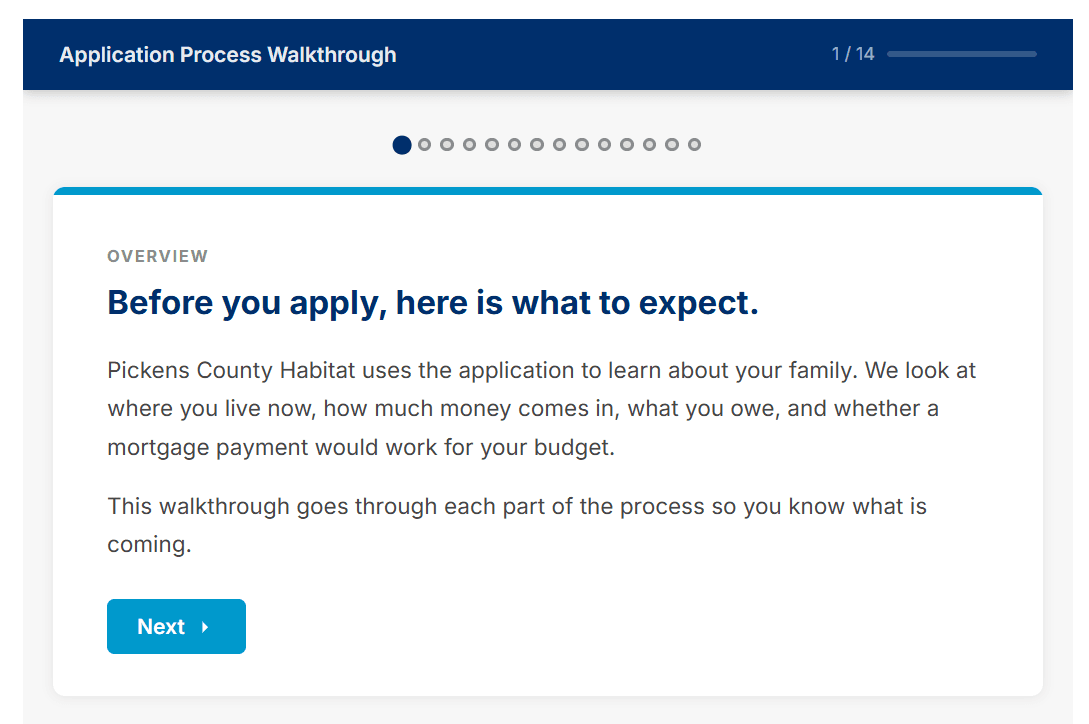
The Pickens County Habitat application walkthrough is free and available now at pickenshabitat.org. It was built with one goal: to make sure that nobody arrives at our application without knowing what they're walking into.
The design is simple. Fourteen screens, one topic at a time, with a progress bar at the top so you always know where you are. The language is plain. There are no assumptions about what you already know.
It starts by explaining why applications aren't always open, because that's one of the first things people want to know and one of the most common sources of frustration. It walks through how to request an application and what to do before you start filling it out. It explains what counts as income, with specific examples, because not everyone knows whether child support, disability payments, or regular help from a family member should be included. It walks through the documents they'll need to gather: a photo ID, Social Security cards, recent pay stubs, tax returns, bank statements, a lease or rental agreement, court documents for divorce or child support, and documentation for any other income sources. Start collecting those now, it tells them, because some take time to find.
It covers debt and monthly expenses, what happens after submission step by step, and throughout, when something might raise a question, there's a phone number and an invitation to call us so we can help you figure it out. The last screen tells people what to do if their application isn’t approved this time. This is important, because many times we aren’t saying no, just not yet.
We’re proud of the work we’re doing to house our neighbors, but we know that work is bigger than simply swinging a hammer. Sometimes it looks like working in css and html to ensure that nobody loses their shot at a Habitat home because the process itself was an obstacle. We’re also excited to announce that this is just one piece of an extended approach to removing barriers we’ve identified across our community. We’ve also launched a specialized Homeowner Education course that provides homeowner partners with a reference they can return to and we’re developing additional tools for the community. Stay tuned to see what’s next.